This is not a manifesto about “AI replacing engineers.” It’s a practical walk-through of three defaults Steinberger shipped into his open-source loop after tokens stopped being the constraint and attention became the scarce resource.
The verdict
Worth the twenty minutes if you already run coding agents daily. The thesis lands: expand what the agent can verify without you. The three demos are concrete and shippable (skills + remote boxes). Treat the comedy and corporate name-drops as stagecraft; the durable idea is more agent tooling until human judgment is the only remaining step — and even then, Steinberger admits judgment doesn’t go away.
1 · The constraint stackTokens → CPU → attention
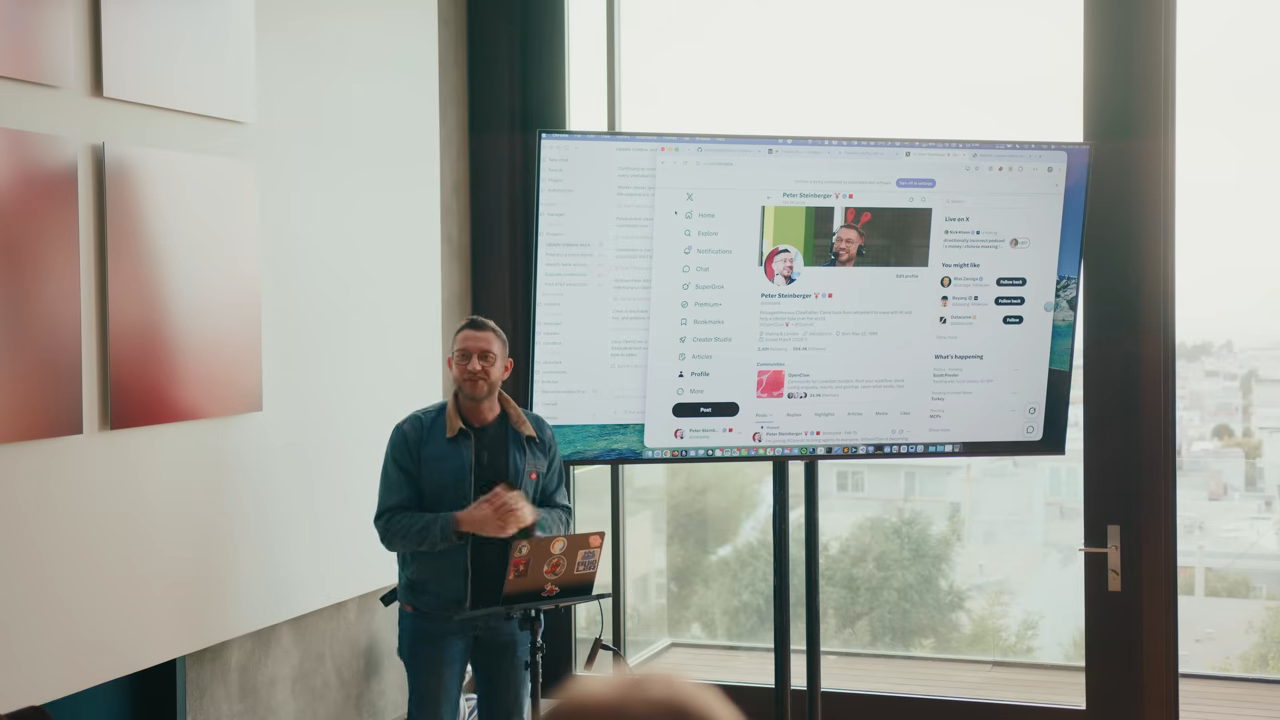
He opens with a joke that also maps the last year of agent economics: tokens used to be the bottleneck (he “fixed” that by joining OpenAI), then local CPU, then the real limiter — how often a human must re-enter the loop. The optimization target is not raw output; it’s how seldom you need to be present for the agent to keep making progress.
"What you really want to optimize when you work is you want to optimize how often do you need to be in the loop with your agent."Peter Steinberger — 01:34
2 · Skill oneAgent transcripts on PRs
OpenClaw’s PR flood includes “type fix #123 into a coding agent” contributions. A long, untrusted diff is hard to prioritize. Steinberger’s response is a default skill: after a PR is created, invite a sanitized agent transcript so reviewers (and review agents) can see whether the author spent a minute or an hour, and how they reasoned.
"The longer your transcript is, the higher is my confidence that you actually care about what you fix or you actually understand or at least try to understand what you fix."Peter Steinberger — 03:44
3 · Skill twoAuto-review back into the coding session
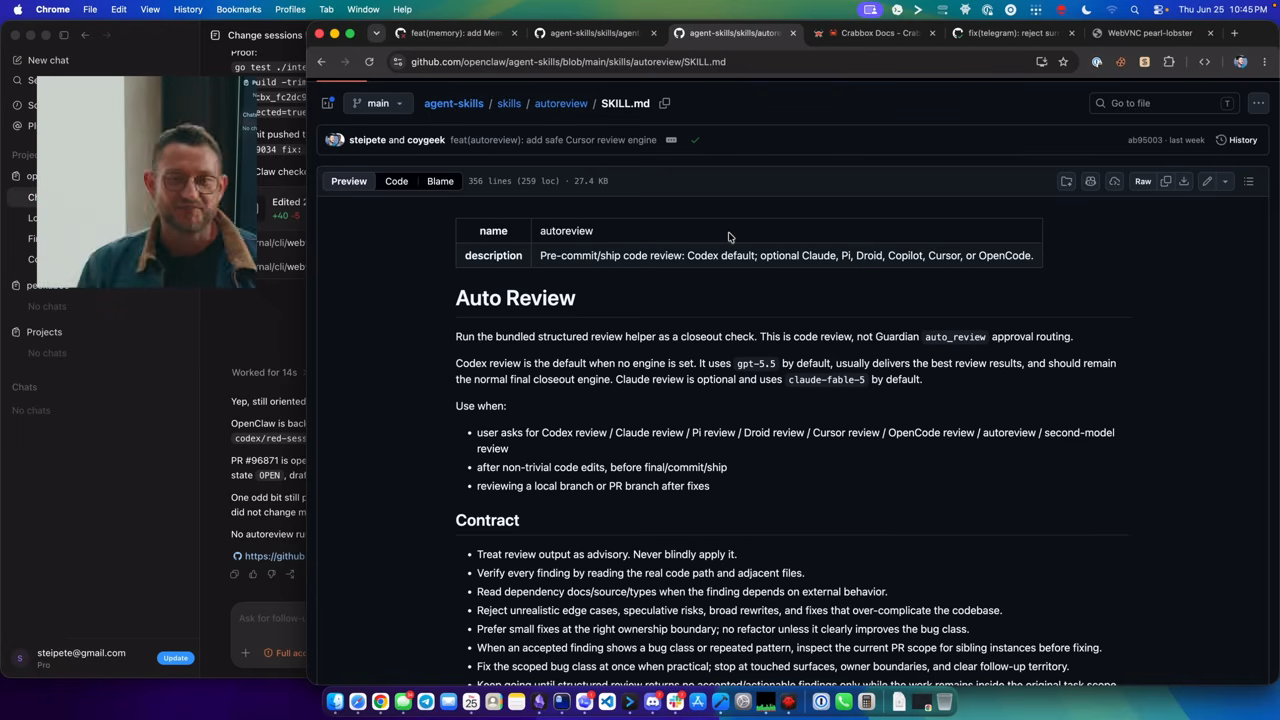
Instead of spinning a disconnected review bot after the fact, a default skill loads on PR/commit and invokes whatever CLI you have (Codex, Claude, OpenCode, etc.). Feedback returns to the same session that wrote the code — which still holds the constraints — so the agent can accept or reject findings and write decisions into the PR description for the next human/agent.
"Somebody would create a PR… do a review… find three things I fix those things but I actually haven't fully understood what the PR is about… and I actually break things."Peter Steinberger — 06:28
The self-own is useful: he jokes the skill is a “massive token burner” that made “Anthropic and OpenAI millions,” and later warns auto-review can go overboard unless you encode invariants (files that must not change post-startup, assumed environment, etc.).
4 · Primitive threeCrabbox: a short-lived box for every run
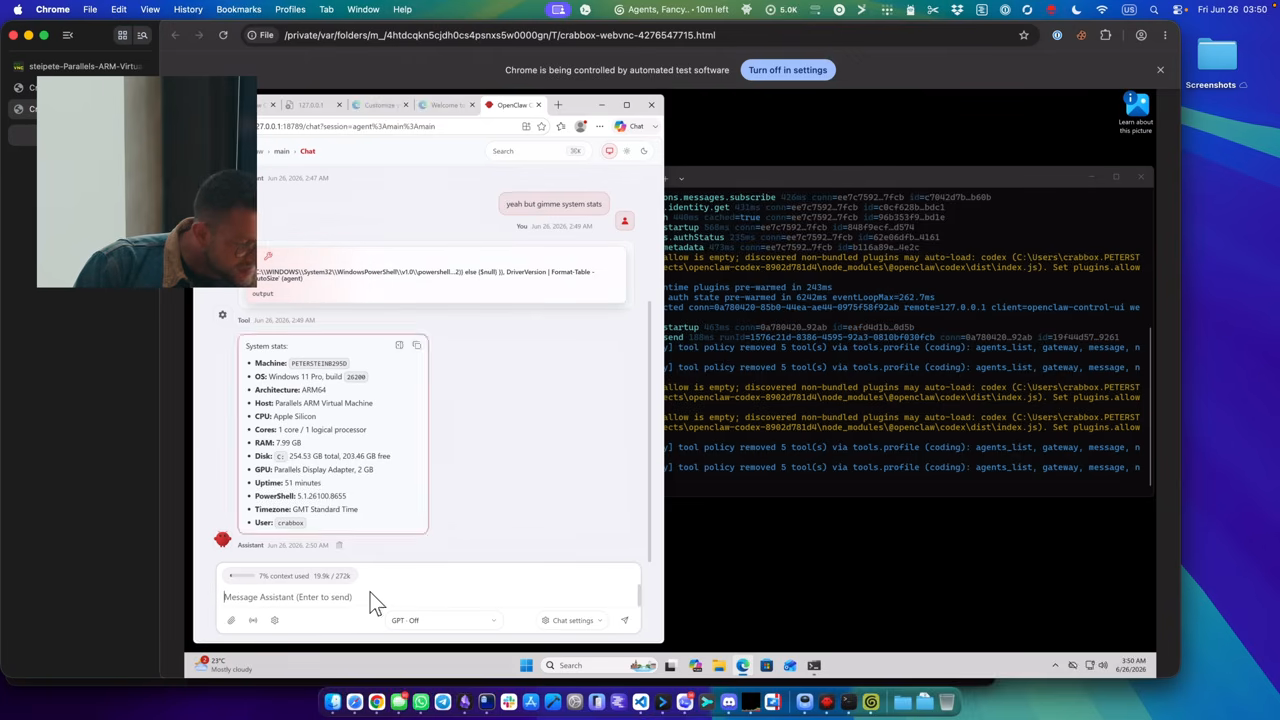
Long multi-session days melt laptops. Steinberger’s third piece is a remote ephemeral box (on screen: Crabbox — auto-captions repeatedly mangle this as “crap box”) that syncs from your repo/CI baseline, runs expensive tests and installs, and supports Linux/macOS/Windows with computer-use (screenshots/clicks) over a fresh environment. Links are shareable so a teammate or non-coder can try a feature via VNC without fighting focus-stealing desktop automation.
"What you really want to do is to increase your confidence that what you actually prompt is something that works. You want to start with a fresh machine."Peter Steinberger — 10:06
5 · Q&ALoops, HITL, and what still hurts
Asked about “loops,” he shrugs the buzzword: issue bots that check vision.md, open PRs, review, and repair are already loops — the point is fewer minutes staring at agent streams. Human-in-the-loop shifted from constant screaming at the model to more up-front intent, then long autonomous runs, then visual before/after checks and merge. Attention is only “solved to a degree.”
"My agents need much less babysitting because you just give them more tools to do the work… but you still need the thinking of like, is this actually something we want? Nobody can take away."Peter Steinberger — 18:07
"What bothers [me] the most… that it still requires so much thinking… agents are just not really good at understanding how does this one thing fit into the big picture."Peter Steinberger — 19:05
As a review of practice rather than a product pitch: the talk is strongest when it treats skills and sandboxes as attention infrastructure, not magic. It is weakest when stage jokes (“dictator for life,” provider name-drops, Pride rainbow demo) outpace evidence about failure rates, cost, or security boundaries of multi-provider remote boxes. Steal the pattern — provenance, in-session review, fresh-box verification — even if you never touch OpenClaw.